Every year, the smartphone market gets more crowded and the marketing gets louder. Every phone is "revolutionary." Every camera is "pro-grade." Every battery is "all-day."
Most of it is noise.
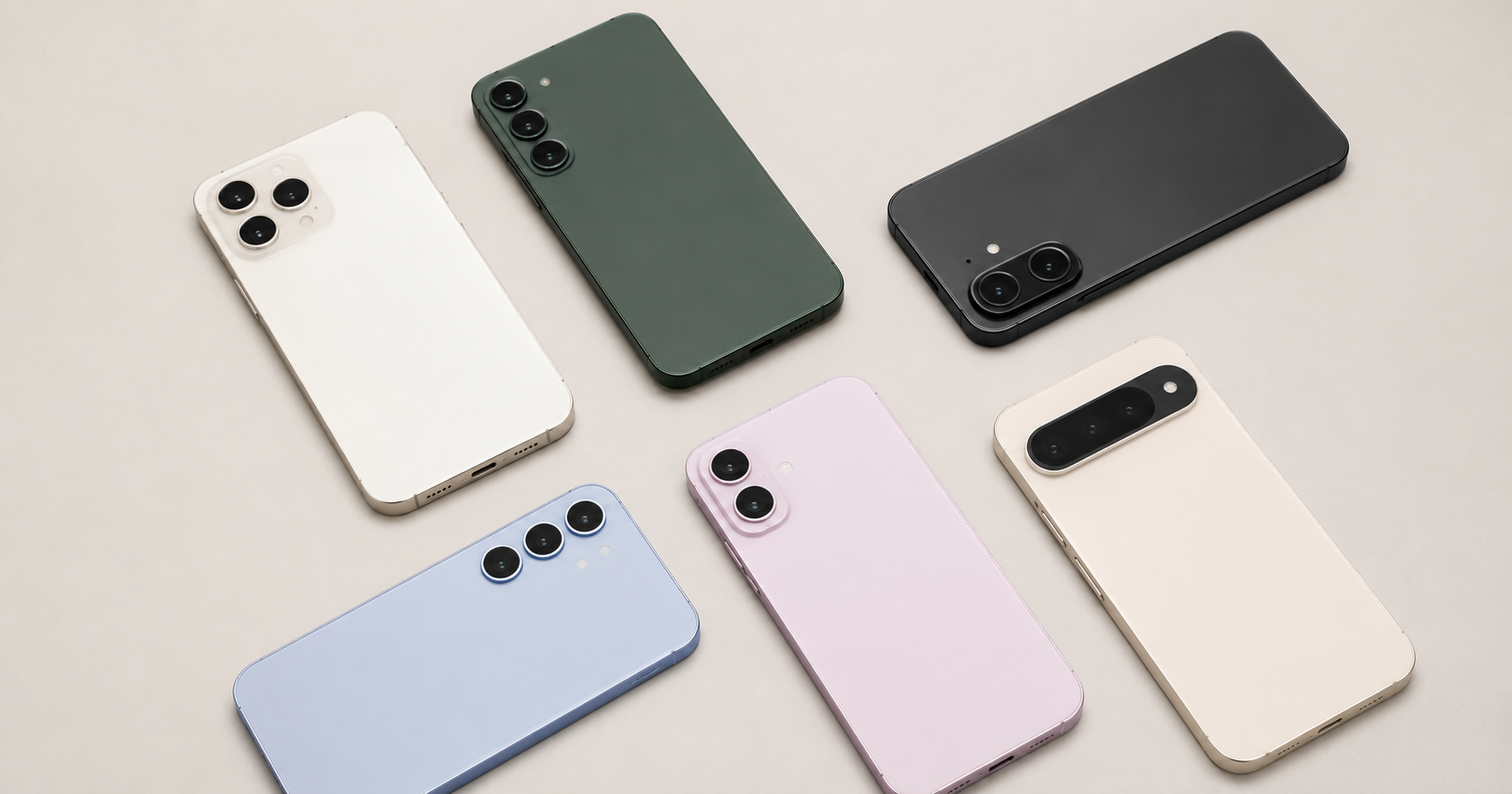
This list cuts through that. Six phones. Six real use cases. One honest take on each.
The Short Version
If you're in a hurry:
| Who it's for | Pick |
|---|---|
| Best overall (Android) | Samsung Galaxy S26 Ultra |
| Best overall (iPhone) | iPhone 17 Pro Max |
| Best camera, best value | Google Pixel 10 Pro XL |
| Best mid-range | OnePlus 15R |
| Best personality | Nothing Phone 4a |
| Best budget | Google Pixel 10a |
Now the longer version — because the right phone depends on what you actually care about.
1. Samsung Galaxy S26 Ultra — The Most Complete Android Phone
If you want the absolute best Android experience and money isn't the deciding factor, the S26 Ultra is where you end up.
The camera system is ridiculous in the best possible way — a 200MP main sensor, two telephoto lenses (50MP and 10MP), and an ultra-wide. Samsung widened the apertures on the main and 5x cameras this year, which makes a real difference in low light. It's also the best zoom phone you can buy right now — nothing else comes close at this price tier.
What else? The display is stunning. The S Pen is still there for people who use it. The build quality is premium in a way you notice when you hold it.
The catch: it starts at $1,299. And if you're an iPhone person, no amount of specs will make it feel right.
Buy this if: You want the most capable Android phone available and don't want to make any compromises.
2. iPhone 17 Pro Max — The One to Get for Video
Apple handed the overall crown to Samsung this year on camera hardware — but if you shoot video, it's not even close. The iPhone 17 Pro Max is in a different league.
ProRes Log support, Dual Capture, high-frame-rate 4K — no other phone in 2026 is positioned this way for serious video work. Content creators who need professional-grade footage in their pocket end up here every time.
The rest of the phone is excellent too. The 8x zoom is optical-quality, the display is gorgeous, and iOS remains the most polished mobile OS available. Battery life is strong.
One note: Apple dropped from 5x to 4x telephoto this year, which some users will notice. The S26 Ultra still wins on zoom reach.
Starts at $1,199 for 256GB.
Buy this if: Video quality is your top priority, or you are deep in the Apple ecosystem and want the best iPhone available.
3. Google Pixel 10 Pro XL — The Smartest Camera
The Pixel 10 Pro XL is the camera phone for people who want to actually take good photos — not obsess over specs.
The secret is the Tensor G5 chip. The hardware spec sheet is not as flashy as Samsung's, but the processing intelligence is ahead of everyone else. Difficult shots — mixed lighting, fast-moving subjects, low light — consistently come out better on a Pixel than they have any right to.
Seven years of OS updates. Clean Android. No bloat. And it costs $300 less than the S26 Ultra and iPhone 17 Pro Max.
Buy this if: You want genuinely great photos without thinking about them, and you value long-term software support.
4. OnePlus 15R — The Mid-Range Overachiever
At $700, the OnePlus 15R should not have Snapdragon 8 Gen 5 inside. That is a flagship chip. Most phones at this price use something from the tier below.
OnePlus made a bet on raw performance and battery life, and it paid off. The 7,400mAh silicon-carbon battery is enormous — reviewers consistently report two to three days of use. Benchmark scores put it above phones that cost significantly more.
The trade-offs are real though. No telephoto lens. No wireless charging. Software support is four years — compare that to Samsung and Google's seven.
Buy this if: You want maximum performance and battery life in the mid-range, and you can live without wireless charging.
5. Nothing Phone 4a — The One That Stands Out
Nothing continues to do something unusual in a market where every phone looks identical: they make phones that look like nothing else.
The Glyph LED system has been redesigned into a cleaner stacked bar. Notification glances, recording indicators, charging status — genuinely useful, not just a gimmick.
The camera is a legitimate highlight: a 50MP primary sensor paired with a 50MP 3.5x periscope telephoto. That zoom range at this price is rare. The 6.83-inch 1.5K AMOLED display hits 4,500 nits peak brightness and Nothing OS feels like its own thing rather than a skinned Android.
What you give up: raw processing power compared to the OnePlus 15R.
Buy this if: You want a phone that makes a statement and want zoom capability without paying flagship prices.
6. Google Pixel 10a — The Budget Pick That Does Not Feel Like One
The Pixel 10a exists to make you question why you would spend $1,200 on a phone.
It runs the same Tensor G5 chip as the more expensive Pixels. The camera still benefits from all the processing intelligence that makes Pixels so good. The software experience is identical to the Pro models.
What you miss: a larger display, the telephoto lens, and some premium build materials. But for everyday photography and daily use, those gaps are smaller than they sound.
Buy this if: You want a genuinely good phone for under $500 and do not need zoom or the largest display.
The One Thing That Matters More Than All of This
The best smartphone is the one that fits how you actually use a phone.
If you spend most of your screen time in messaging apps and social media, a $1,299 flagship does roughly the same job as a $400 phone. If you shoot video professionally, the iPhone 17 Pro Max justifies every dollar. If you want your phone to last four years without slowing down, the software support timeline matters more than the chip speed.
Buy accordingly.
Prices and specs based on manufacturer listings and major review outlets as of July 2026. Prices may vary by region and retailer.
Written by